Table of Contents
Through a close reading of select L.M. Montgomery textual appearances in North American cultural magazines and newspapers, this article draws on my ongoing research and the foundational works of Benjamin Lefebvre and Sarah Galletly to investigate how these appearances enabled Montgomery to maintain a proto-feminist, resilient writing practice of equally proto-feminist social critiques amid an era of male, modernist literary criticism in Canada.
In 1916, L.M. Montgomery wrote “The Alpine Path: The Story of My Career” at the invitation of Everywoman’s World’s Toronto editor. This extended essay, published sequentially over several months, is what Benjamin Lefebvre calls the “most detailed autobiographical account that Montgomery published during her lifetime” (A Name 231). Here, in her lesser known, non-fictional voice, Montgomery reflects on the importance of her first periodical publication:
I won the prize of five dollars offered by the Halifax Evening Mail for the best letter on the subject, “Which has the greater patience—man or woman?
My letter was in the form of some verses, which I had composed during a sleepless night … On Saturday the Youth’s Companion sent me a cheque for twelve dollars for a poem. I really felt quite bloated with so much wealth. Never in my life, before or since have I been so rich! (Lefebvre, A Name 282)
Montgomery goes on to quote her own journal from the time, explaining the exhilarating and empowering practice of writing and publishing:
I have grubbed away industriously all this summer and ground out stories and verses on days so hot that I feared my very marrow would melt and my gray matter be hopelessly sizzled up. But oh, I love my work! I love spinning stories, and I love to sit by the window of my room and shape some “airy fairy” fancy into verse. I have got on well this summer and added several new journals to my list. (Lefebvre, A Name 283; cf. Montgomery, CJ 2 [23 Aug. 1901]: 19)
Grounding herself as a career writer—writing to earn and earning to write—Montgomery frames her origin story as a labour of both affective, joyful creativity and a logistical practice of business. In this image of herself, two motivations dovetail to shape her authorly identity. She both eagerly and industriously counts the publications and dollars she has earned, and she spins stories in the light of her bedroom window, at the loom of “airy fairy” verse.
Montgomery’s periodical pieces capture these complexities, dwelling in a liminal space between the hopeful brightness of her novels and the increasingly melancholic contemplation of her extensive journals. In this middle space, she keeps her keen eye on the public, offering her social opinions and self-fashioning as modes of maintaining her writing career with writings on relevant issues about which she was passionate. Montgomery resides at a strange intersection in Canadian literary studies—as both highly influential, widely read, and yet, a writer who had to navigate persistent socio-political structures that rendered her work precarious in the Canadian literary writing community. I argue that, in the ephemeral and topically attuned periodical, we can read sites of Montgomery’s proto-feminist discourse outside of her popular novel form. Furthermore, these publications were where Montgomery was able to challenge the increasingly gendered literary critiques that troubled her creatively and financially. As her novels socially and economically depreciated, the periodical remained a space for Montgomery’s self-sustaining writing practice, both in its capacity to negotiate increasingly androcentric literary cultures but also to reach casual readers to offer subversive women’s narratives as social interruptions.
Montgomery amid the Moderns
Montgomery scholar Elizabeth Waterston asserts that Montgomery “[knew] her words [were] her tools” (219) and that this was her way to “exploit her experience in an enduring art-form” (198). While beloved for her Anne novels, in Montgomery’s later career, through the 1920s and 1930s, her trajectory as an active author would change. In the same year as “The Alpine Path” was published in six instalments from June to November 1917 in Everywoman’s World, Montgomery was already publishing her fifth book in the Anne series, Anne’s House of Dreams. Managing expectations of her publishers and conscious of her national and international sales, Montgomery began to navigate the decades of new modernist literary activity in Canada and an emerging scholarly discourse on literatures in Canada.
In 1921, the Canadian Authors Association (CAA) was founded to make advances in copyright law and host postwar discourses about a national literary culture, which had already begun edging out “sweetly sentimental and patriotic verse imitating Romantic and Victorian poetry” (Rubio 300). Kate Sutherland’s “Advocating for Authors” examines Montgomery’s experience and position in the CAA throughout the 1920s and 1930s as an eager and active member who often proposed ideas to improve the efficiency and impact of the group. However, by the late 1930s, as Sutherland writes, “even as second vice-president, she does not appear to have had the power to put her ideas into effect.” One reason for this, Sutherland argues, is the “members of Canada’s developing literary old boys’ network who had openly expressed disdain for Montgomery’s writing” (229). Mary Rubio’s biography, The Gift of Wings, details how Montgomery’s stylistic “features were on Modernists’ scorn list[s]”; for example, she was denigrated for her lyrical prose used to “describe beautiful natural landscapes; girl heroines who were full of passionate emotional responses to life; humorous treatment of the vagaries of human nature; an affectionate view of humanity shown in the characters’ zest for life and concern for each other; and tidy happy endings—which were labelled ‘sentimental’ by the critics” (301). As Montgomery participated in meeting rooms and critical cultural discourse with her Canadian literature colleagues and critics, she had to defend herself from accusations that her pre-war novels were simply pablum for “sentimental, foolish young girls” (Rubio 300). In this era of a literary critical turn from Victorian, colonial style and content to a uniquely emerging North American or Canadian form and focus, critical discourses dredged in misogyny survived and mutated to constitute a modern patriarchal culture of literary studies.
In the 1930s and 1940s, influential critics, such as William Arthur Deacon of the Globe and Mail, identified that the greatest modern novelists in Canada were covering wartime and post-wartime experiences, with more serious, cynical, and realist narratives of life than Mongomery’s “sentimental” tales. These critics have been colloquially called the “Bobcaygeon Boys”—members of the Canadian Authors Association (CAA), some of whom owned Ontario cottages and property in the same area (Walker). Alongside Deacon, this included scholars and writers such as Arthur Phelps and E.J. Pratt (Walker). This circle came to define the highest standard of writing for the modern era. In their own work and critical studies, they engaged in the emerging critical studies project of establishing signals, symbols, and themes to represent a national literature for Canada. For example, throughout the letters of Deacon, exchanged with other Canadian literary giants such as Hugh MacLennan, many of these notable male figures identified that Gabrielle Roy’s gritty portrait of a family in the wartime Montreal slums, Bonheur d'Occasion (1945), was the “greatest novel ever produced by a Canadian” (Lennox and Lacombe 211). Roy and Montgomery were both active Canadian female authors writing about complex families in regional Canadian contexts; however, writers like Roy were being celebrated for their deeply internal, dark, and socio-politically cynical lenses, while writers like Montgomery were being situated by critics as a foil of how not to write “the real”—scorned for her thematic choices and status as a celebrity, a popular fiction writer. Through reviews and articles, literary critics circulated that both Montgomery and her readers simply did not understand the new modernist interests of realism in Canada, especially its tones of “skepticism and cynicism” and themes of “alienation and isolation” (Rubio 300).
With regard to the attitudes and themes of Montgomery’s texts, the modernist critics were not entirely incorrect in their impressions. Montgomery did indeed loathe the “depravity, defeat, and destruction in modernist writing” (Rubio 301); however, she was not an unserious or socially unconscious writer. Rather, her narratives were devoted to a sense of resilience through humour and optimism, with socio-political suffering and challenges nestled in the background of her characters’ lives. Her most popular character, Anne, confronts misogyny, experiences unpaid domestic and emotional labour, and intimately knows domestic violence. Anne is also the child of an early Canadian welfare system and often navigates her own trauma responses with her imagination. Alongside Montgomery’s lyrical style, which often gazes into regional scenes where lakes shine and kindred spirits exist, her writing carries topically relevant socio-political statements about resilience and survival for many Canadian readers. For Montgomery, female characters such as Diana and Marilla are not merely filler characters to react to Anne’s mischief and sweetness. Montgomery crafts a structure of chosen family in which creative sites of feminine care enable survival and well-being in response to state and social harms.1 And, yes, to the chagrin of modernist critics of her time and many to follow through decades of Canadian Literature studies, these moments occur in relational exchanges and dialogue as they discourse over cream puffs, race through a haunted wood, and come head-to-head with the social sinews of regional life. To separate the stylized details and passages of realism alongside Montgomery’s idyllic and women-centred narratives is a reductive mistake—these sites of kinship with the land, her community, and her resilient gaze upon the world make Anne a complex and compelling character for readers and in Canadian literary history. What is equally as compelling is how Montgomery persisted in her writing practice as a publishing and earning woman writer, wielding her popularity to stay financially afloat in a time rife with difficulties for her.
In the case of Montgomery versus the “Bobcaygeon Boys,” Montgomery arrived in the literary circle of the CAA already facing the financial and reputational losses of misogyny’s gain, which had depreciated the quality of her novels and, therefore, the sales of her ongoing works. For years, Montgomery had published with Boston’s L.C. Page and Company, who shorted her on royalties and would later publish an unauthorized sequel, Further Chronicles of Avonlea, as well as sell the film rights to the Anne series without her permission. By the late 1920s, Montgomery had experienced a series of lawsuits, countersuits, and appeals to advocate for her deserved earnings (Urquhart 49–50). Amid the settlement from these cases, the Bobcaygeon critics continually dismissed Montgomery in periodicals and essay collections and would, as her biographer Jane Urquhart writes, “nudge [her] literary reputation into a downward spiral from which it would never recover until years after her death” (51). In his 1926 collection, Poteen: A Pot-Pourri of Canadian Essays, Deacon led the critical charge, socially forcing Montgomery “out of serious literary consideration, but also out of the Canadian Authors Association” (Urquhart 55). He condemns Montgomery’s prose as “sugary stories,” representing a “Canadian fiction” that should “go no lower,” and goes as far as to say that her work should be comparatively held up to modern Canadian works only to “show the dearth of mature novels” (169). As Holly Pike and Laura Robinson discuss in their introduction to L.M. Montgomery and Gender, modernist print discourse in periodicals and books critiqued and devalued Montgomery’s works for their supposed lack of serious or relevant realism because of their focus on “childhood, rural life, and female-centred existence” (5–6). However, as Waterston reminds us, amid this anti-Montgomery discourse of the 1920s and 1930s, Montgomery’s words remained “her tools” (219).
Periodical as Pulpit: Rendering Visible Complexity and Craft
Critics followed Deacon’s example, including Phelps, writer and Professor of English at McGill University, who included Montgomery in his essay collection on Canadian writers but only to denigrate her as merely a writer of “popular mediocrity” (86). He summarizes Montgomery’s impact broadly and dismissively: “There are few rich passages of really good writing. It raises no great issues and seems unaware of problems that habitually vex the contemporary mind. It is soft reading” (87). Phelps beckons the reader and cruelly teases Montgomery: read her work “just for fun, if you can” (93).
Critics followed Deacon’s example, including Phelps, writer and Professor of English at McGill University, who included Montgomery in his essay collection on Canadian writers but only to denigrate her as merely a writer of “popular mediocrity” (86). He summarizes Montgomery’s impact broadly and dismissively: “There are few rich passages of really good writing. It raises no great issues and seems unaware of problems that habitually vex the contemporary mind. It is soft reading” (87). Phelps beckons the reader and cruelly teases Montgomery: read her work “just for fun, if you can” (93).
Between Phelps and Deacon, their criticism of Montgomery’s work often stops at the acknowledgement of her popularity among girls, despite brief admissions that her novels are widely published and read. While Phelps is willing to concede that since Montgomery’s books are so popular, this “usually suggests the presence of positive and fundamental qualities” (89), he maintains that her work is not to be called “literary” in relation to the construction of its form and rather simply “has its public and performs a function for that public” (88). In his analysis, Phelps does not directly name this specific public of Montgomery’s until later in his chapter, where he acknowledges Montgomery as a “respectable” storyteller of the past for young girls but predicts that she would be read in the 1950s only by the “uncultured and unsophisticated.” He writes, “For the modern there is stronger meat. Even for the modern little girl there is stronger meat” (90). Such critiques fail to analyze Montgomery’s literary techniques, devices, and socially charged narratives. Rather, they stop short at the gendered judgment of Montgomery’s characters and audiences, ever devalued for their femininity.
Similarly, and yet in an even more critically biting tone, renowned Canadian literary critic Desmond Pacey addresses Montogomery’s authorship in his later 1952 study, Creative Writing in Canada. This book, largely “regarded as a crucial and decisive text that helped develop concretely the history of English Canadian literature” (Murcia), along with earlier critiques by the Bobcaygeon Boys, continued an established tradition of negative Montgomery discourse and torpedoed her literary reputation in ongoing Canadian literary studies. Pacey asserts that not only is Montgomery’s content less than substantial but that her writing quality cannot be judged by “adult critical standards” (106). These reviews of Montgomery’s work are rife with highly conditional praise and an overall reluctance to acknowledge her as a writer of real literature. In his critique of Montgomery, Phelps excludes her from a literature “valued for quality of form” (“Literary”). Ultimately, this is the common thread among Montgomery’s professional and scholarly critics. They denied critical attention to both the form and the social complexities of her work due to the gendered devaluations of her characters and to her as an author. To devastating effect, they united in agreement that her writing had little technical or formal skill to be discovered by adult readers. However, utilizing the periodical setting as a site of resistance, these are critiques that Montgomery consistently refuted through her articles and features.
Lefebvre fills L.M. Montgomery Reader: Volume One: A Life in Print cover to cover with Montgomery’s confident public interviews and essays that detail her authorly process and the concern for quality. For example, in a 1915 edition of Everywoman’s World, Montgomery appears twice. First is an article titled “What Twelve Canadian Women Hope to See as the Outcome of the War,” in which she makes the stern socio-political statement that “the women who bear and train the nation’s sons should have some voice in the political issues that may send those sons to die on battlefields” (136). And in the second, “The Way to Make a Book,” Montgomery speaks directly to the young women readers of the periodical and to young aspiring writers, instructing them on how they might sharpen and publicize their voices in their writing: “Before attempting to write a book, be sure you have something to say—something that demands to be said” (138). Unlike those critics who deem her feminine narratives to be “unpretentious to the point of being naive” and in “close cousinship with ignorance” (Phelps 88), Montgomery encourages women readers (and potential women writers) to honour the importance of what they know in their everyday lives: “if we have something to say that will bring a whiff of fragrance to a tired soul and to a weary heart, or a glint of sunshine to a clouded life, then that something is worth saying, and it is our duty to try to say it” (“The Way” 138). Thus, Montgomery utters important encouragement of Canadian women’s literature into the canon, highlighting it as not being “naive” or “ignorant” but as having “something worth saying.”
The remainder of this article is an in-depth exploration on how she believed quality literature should be crafted, consistently claiming that her writing, as any good writing, is indeed one of formal literary technique in service to the “central idea.” Like many modernist writers, she thought that a plot was no longer needed and that “many very successful books have little or no plot,” nevertheless imploring that books must be planned, “worked out with care and skill,” and “cut, prun[ed] and [rewritten]” to “partake of the essence of true art” (138). Here, she establishes herself as a writer of “true art,” rather than, as her critics argue, simply a popular writer for a sentimental and uncultured public. In direct defiance of her foremost modernist literary critics, she pleads with her readers,
Write, I beseech you, of things cheerful, of things lovely, of things of good report. Don’t write about pig-sties because they are “real.” Flower gardens are just as real and just as plentiful. Write tragedy if you will, for there must be shadow as well as sunlight in any broad presentment of human life ... Never mind if some blase critic sneeringly says that your book will “please the Young Person.” You may be justly proud if it does. The Young Person’s taste is well worth pleasing. (141)
Ultimately, the article closely reports an authorly practice and commitment to literary production from which her critics so often exclude her. Montgomery utilizes this periodical platform to make known her craft and simultaneously usher forward encouragement for other young women writers like her.
Writing and Responding to the Canadian Public
At this point, I turn toward Montgomery’s appearances in periodicals during the modernist decades from widely read publications like Toronto’s Chatelaine to small news presses like the Charlottetown Guardian. These publications enabled her to do what Sarah Galletly describes as “controlling her own status as both a public figure and a ‘celebrity’ author” while maintaining her “intended readership,” which was ideally young women like those she wrote about (24). Rather than revealing only a softness, her literature and literary practice also reveal a flexibility, a product of that softness, that adapts, critiques, and attunes to a changing, toughening time. In my exploration of these materials, I pose the question: how might readers of the time have been able to witness unconventional women’s experiences and subtly complicated incursions into hetero-patriarchal Canadian narratives? Ultimately, investigating Montgomery’s social critiques reveals her skill as a writer, proving that women’s social issues and discourses around women in the public sphere were to be taken seriously. This brief study attempts to redirect her reputation from the literary precarity that modernist discourse threatened by reframing her as both an author of formative and popular youth novels and a discerning, socio-political writer.
To trace Montgomery’s resilient literary practice from the periodical to the novel, I am curious how she not only focuses on the stories of young women but also weaves socio-political statements into these textual spaces. For example, in many of her periodical pieces, she continues practices that she was criticized for in her novels—lyrical writing about the feminine quotidian and the importance of imagining a different future for young women. When the style of her novels was publicly challenged by her literary peers, she enabled her writing practice to survive through her periodical publishing and continued working in her chosen style. In the world of periodical publication, Montgomery was a poet, columnist, critic, autobiographer, and essayist. She was printed and reprinted from coast to coast in Canada and in the United States and Europe. For her high representation in magazines and newspapers in central Canada, such as MacLean’s Magazine, Canadian Home Journal, the Ladies’ Journal, and The Globe (“Periodicals”), I begin my brief study of Montgomery selections from the popular Chatelaine magazine based in Toronto. During this era, “Chatelaine ran heavy content of fiction, recipes, beauty, fashion, child care, and etiquette, with emphasis on the role of woman as homemaker” (“Chatelaine Magazine”). On the socio-political spectrum of Canadian women’s magazines at the time, Chatelaine was interested in the young, the trending, and the progressive, but was always grounded in gendered discourse of the nation and the gendered domestic sphere’s importance in upholding the national status quo.
From its 1928 beginning, Chatelaine’s articles showed images and narratives of the strategically limited domestic spheres of Canadian women as well as conservative values.
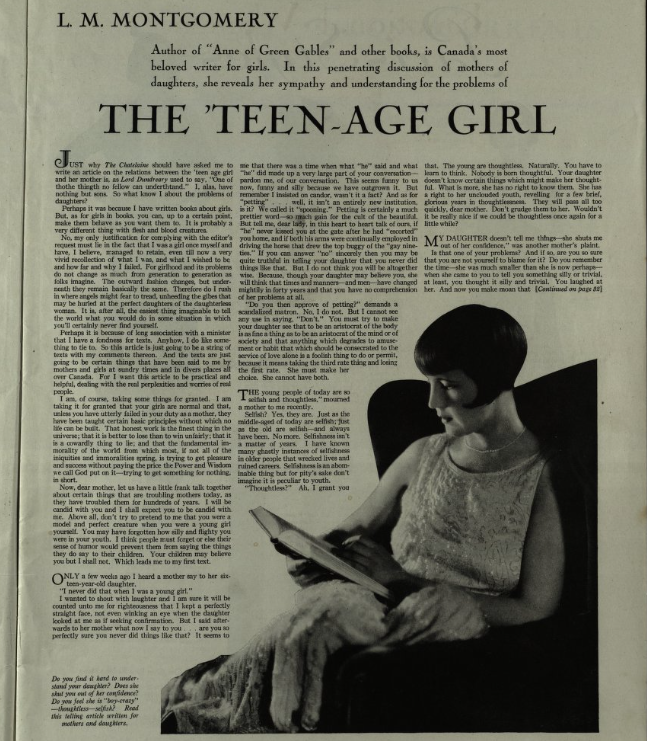
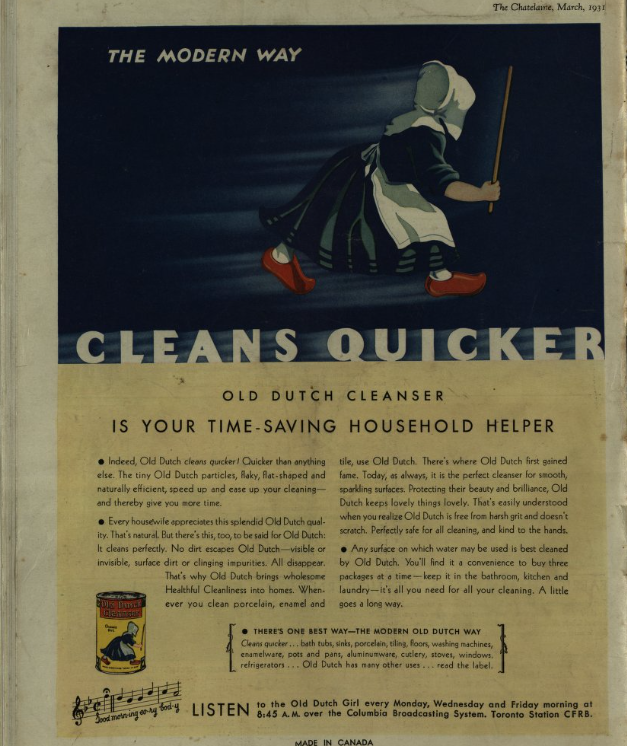
For instance, Montgomery’s 1931 Chatelaine article “The ’Teen-Age Girl” is bookended by advertisements about housekeeping products and maintaining aesthetic dental beauty for women. That being said, the magazine was concerned about social change. As an example, within the first years of print, following Canada’s landmark Persons Case, the magazine featured Emily Murphy’s reflection on “what lay ahead for women now that they were considered persons under the law” (“Chatelaine Magazine”). And while Chatelaine historically documents shifting power relations regarding women in Canada, these power relations consistently remain tied to their legal, white, nationalist definitions of “woman” and “Canada”—each inevitably inseparable from their existing, interlocking structures. It is at this intersection that Montgomery offers unique contributions to the magazine’s social scope.
By 1928, Montgomery was a celebrity author, with Anne of Green Gables and most of its sequel texts published. She was also well regarded as a spokesperson for the experience of Canadian girlhood. This is why Chatelaine seems to have turned to Montgomery. In their ten-cent March 1931 edition, Chatelaine prefaces Montgomery’s “The Teen-Age Girl” by saying, “Do you find it hard to understand your daughter? Does she shut you out of her confidence? Do you feel she is ‘boy-crazy’—thoughtless—selfish? Read this telling article written for mothers and daughters” (273). In response, Montgomery opens her article by offering, “Just why The Chatelaine should have asked me to write an article on the relations between the ’teen age girl and her mother is, as Lord Dundreary used to say, ‘One of thothe thingth no fellow can underthtand’” (273). While she concedes to being well known for writing a popular story about a young Canadian woman, Anne Shirley, she opens the piece by displacing her natural alignment with Chatelaine’s usual topics and themes of traditional, structure-bound womanhood. She identifies herself as different from the Chatelaine’s desired social discourse about the standardized upkeep of “the Canadian woman.”
Throughout her piece, Montgomery engages with a site of insecurity for both the Canadian nation and its mothers: the problem of the “silly … flighty” (274) and rebellious young woman. In this article, with every argument upholding a national rhetoric of anxiety around the mobility and choice of young women, Montgomery responds assertively. She argues for the selfish and thoughtless daughter: let her be thoughtless. She writes of the mother trying to rigidly steer her daughter toward propriety: “remember she is wise with the wisdom of the young … Let her do the planning herself. Don’t force her into a mold” (278–79). She advocates that the romantic, intimacy-exploring daughter be allowed to explore:
But tell me, dear lady, in this heart to heart talk of ours, if “he” never kissed you at the gate after he had “escorted” you home, and if both his arms were continually employed in driving the horse that drew the top buggy of the “gay nineties.” If you can answer “no” sincerely then you may be quite truthful in telling your daughter that you never did things like that. (275)
Montgomery closes her article with a resounding message directed to Canada’s young women: “[W]e want you to have rich full lives, quench your thirst for living at the unknown, enchanted springs we sought and could not find, do all the wonderful things we wanted and failed to do. We want you to have more real freedom, not merely more apparent freedom, than we had to develop and expand” (280–81). Montgomery uses Chatelaine’s mother-daughter article to explicitly push against internalized misogyny as an intergenerationally reproduced patriarchal harm. Here, her social assertions were of Chatelaine’s interest, as they commissioned and published the piece, still within the polite-enough parameters of patriarchal and social rhetoric, while being topical and perverse enough to warrant interest. However, it is significant that Montgomery opens her article by pointing out her awareness of the limitations of the magazine, as can be seen in her confusion of why Chatelaine would consult her on the “problem” of girlhood. This makes her request for young women’s access to choice diverge even more radically from the magazine’s neighbouring advertisements on beautifying “Pepsodent” and Johnson’s floor wax. In this way, Montgomery’s work inherently becomes subversive due to the way it stands out within a weekly consumable periodical of idealized Canadian productive femininity in order to offer unconventional social ideologies for young readers.
Montgomery’s 1931 piece in Chatelaine is fierce. And this stylistic tone stretches even deeper in other periodical publications. Besides essays, short creative pieces, and articles, Montgomery engaged toe-to-toe with reviewers, amateurs and professionals, who publicly dismissed or disregarded her writing in a shifting literary culture. The Charlottetown Guardian ran a series of letter-style reviews from August until September 1930 of Montgomery’s 1929 novel Magic for Marigold in their “Public Forum” column. In this forum, multiple public reviewers incited debate over Montgomery’s skill and ability to fictionally represent regional Canadian men and women in the new era of realism in popular literature. The language of the informal reviews reflects the tone of Montgomery’s harsher, more prominent critics like the previously mentioned Deacon and Phelps. In fact, much like Phelps’s condescending call for readers to take up Montgomery’s work “just for fun, if you can” (93), some of these reviewers echo this sentiment in their description of their reading experience. For example, an American tourist spending her summers in Prince Edward Island, Mrs. Edith Frank Fisher, writes to the column editor, “By the way I was fortunate in getting her latest book, 1930, and so I felt I would get a modern version of the Island and so with a pleasurable emotion sat down to read.” She “scanned over the pages lazily,” expecting a narrative from Montgomery that was not fulfilled (263). The movement of literary interest toward modern texts includes a desire for what readers in these columns call “real.” However, in their reviews, some found Montgomery’s text to be unrealistic, “antiquated,” and “mosaic” in character and setting (Fisher 263). Fisher writes of the way Montgomery playfully crafts regional men’s and women’s foibles: “If I lived on the Island—belonged to that ‘purple clan’ of aristocracy that she so well emphasizes, I would certainly resent her exposing such bigotry if it were unreal” (263). As a visitor, enamoured with the Island’s summer, Fisher’s version of “real” seems to seek the ideal Canadian character, one that is polite, reasonable, and upholds a “modern version of the island” in which there is no conflict driven by the humorous fragility of regional priorities, family, or gender traditions.
Spurred by Fisher’s review, one of the “Public Forum” readers with the nom de plume “Islander” writes, “I never knew of such stupid, ridiculous and monstrous criticisms as those mentioned ... This book must be purely fiction, but, if good fiction should depict life in its real sense, then such literature is evil and a source of injury to our Province” (265). Some examples to which this “Islander” takes offence are detailed in Fisher’s original review, where she scoffs at Montgomery’s portrait of an old bachelor who “comes back to the Island and finds its girls unsuitable for marriage,” describing them as “ornamental by candlelight but unbearable at breakfast—a purring, blinking, sidling, clawing bunch, gifted with tongues of gossip and temper” (263). Fisher similarly spurns a tale in which a woman has twins twice, just to spite her mother-in-law who did not want her to have so many children (264). She finds this silly, callous, and no doubt insulting to the real gentlemen and women of the Island.
Another reader-reviewer, under the title “Insider,” writes to the forum that Montgomery is “uncharitable” to her Maritime community and ignorant to how Islanders thirty years ago were a “richer body of men and women” (267). “Insider” admits of today’s Islanders that they face a socio-political and economic reality of struggles that “suppress[es]” their “saving qualit[ies]” (267). However, she admonishes Montgomery for teasing communities who otherwise demonstrate a “splendid type of manhood and womanhood” based on their Maritime traditions, customs, and “inherited good qualities” (267). In this case, Montgomery’s complex and humorous critiques are rejected by readers—the ways in which she proverbially and humorously punches up at a misogynistic bachelor and his anxiety surrounding big, loud, outspoken women or at the domestic expectations of childbearing. These “Public Forum” reviews from Fisher and other readers are short but resounding, calling into question Montgomery’s ability to construct “realistic” fiction or, more specifically and ironically, fiction that both romanticizes Maritime Canadian people and their gendered characters while also remaining, in some way, “real.”
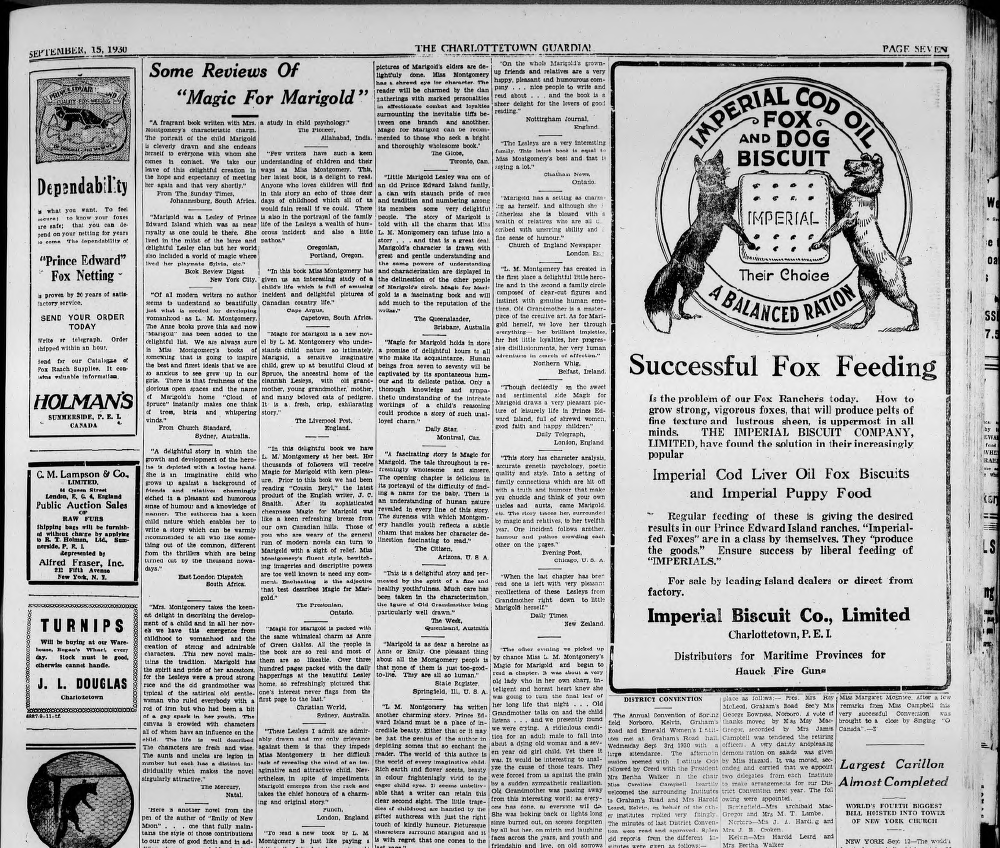
Montgomery deftly responded to the Charlottetown Guardian’s “Public Forum”: “Recently a letter … of which the logic and sense of humour appeared to be about on a par … appeared in your columns, attacking my book, Magic for Marigold. I had a good laugh over this letter and had no intention of taking any notice of it. But others have followed it containing statements and insinuations which, in justice to myself, I cannot ignore” (“Letter 6” 268). Here, Montgomery takes advantage of the public-facing periodical and voices a personal resistance to the public-forum readers who question her ability as a skilled, socially conscious and exacting writer. In her response, Montgomery also takes on the larger cloud of criticism that has been shadowing her for years. She writes to dismantle an all-too-familiar bandwagon of criticism that denounces her ability to write fiercely and socially due to the humour and playfulness in her texts. Montgomery defends her blended literary style for the readers in the Charlottetown Guardian:
The heroine of the book is a little girl, living a very quiet life in a Prince Edward Island farm community ... Prince Edward Islanders can afford to be called Mosaic. ...
I avow … let the consequences be what they may … that I have known a few myself. Do my fellow-islanders want me to depict them as wingless angels, perfect in every respect … and as dull and insipid and uninteresting as such creatures would be? No, I have too much respect for their common sense to think that of them ...
My characters are “types” that are found wherever human beings congregate and I cannot help it if an occasional cap fits. (“Letter 6” 268–70)
In the above passage, Montgomery provides an example of how she discursively and publicly takes control of her narrative as an intentional writer, asserting that it is not silliness or sentiment that skews portrayals of her community. Rather, she has made narrative and stylistic choices to form her societal critiques of rural Canadian traditional masculinities, femininities, and provincial characters. Finally, Montgomery clearly and simply states her beliefs and intentions, rebutting her readers by affirming her unique writing practice and narrative style in the current Canadian literary scene:
I write fiction … not history or biography. And I shall continue to write of Prince Edward Island and its people as I see them, through loving and sympathetic eyes: but I shall not be deterred from poking a little kindly fun at some of their foibles … or even their faults … for fear that I shall offend the susceptibilities of visitors from “the States” or even of ultra thin-skinned islanders themselves. (“Letter 6” 271)
Much like Montgomery’s work in Chatelaine, this letter advocates for a flexible, imaginative, and yet discerning style of character- and narrative-building. Moreover, she exploits the periodical space to affirm her position as a writer concerned with addressing communities, behaviours, and social trends within her time. Ultimately, the exchange in the Charlottetown Guardian starkly challenges what both professional and unprofessional reviewers came to circulate in Montgomery’s late career, that she was a provincial writer whose “popularity merely proved her ‘lowbrow’ quality” with little serious socially relevant narratives (Rubio 4). Instead, Montgomery responds in a direct epistolary mode to her public-facing Canadian audience. She asserts that she is a writer capable of social critique alongside her lyrical optimism, lightness, and humour—and most importantly, that she “shall continue to write” (“Letter 6” 271).
Mapping Montgomery’s Resilience
Montgomery’s contributions to periodicals of her time are diverse in style—personal, political, and both at once. Montgomery curiously pushes at the boundaries of what it means to be properly “woman” in “Canada” and works hard to survive the conditions of what it means to be a writing woman in Canada. As disserviced and disfavoured as she was in her later career, the archival tracing of Montgomery scholars today, of her journals to her articles to her fiction, holds the power to posthumously defend Montgomery as not only an important historical figure in Canadian Literature but also one who keenly vocalized the complex social structures of her time and dreamed beyond them. As Urquhart writes in her study of Montgomery,
Essentially, she gave permission to succeeding generations of Canadian writers to mythologize their dusty small towns and marginal farms, their daily lives and those of their seemingly unexceptional neighbours. … Perhaps the most important is the universal perception provided by Montgomery’s work that the imagination is a liberating force in the face of oppression, whether that oppression is exemplified by a collection of unyielding and controlling adults or a rigid totalitarian regime. No one is truly powerless as long as they possess an inner life. Montgomery and her readers knew this, even if her critics did not. (57–58)
Alongside Urquhart and others, I assert that when Montgomery was losing her foothold in Canadian popular literature, she remained within her readers’ sightlines through her publications in periodicals. Upon critical attack, she turned to the discursive periodical space for women and girls. She kept writing, and she kept earning. She kept offering texts that demonstrated how her social perspectives and literary style could push at the conventions of a nation, its gendered traditions, and the way those traditions are textually reproduced or challenged. In a way, the ephemeral nature of periodicals only makes this work more of an imperative in recasting Montgomery’s publishing history as not only an act of survival but a proto-feminist site of defiance and self-assertion in the face of social, critical risk of disappearance. This style of publishing required of her creative persistence, repeatedly committed to amid an androcentric collection of critics closing ranks around a socially constructed national literary identity.
As a graduate student and scholar new to thinking and writing critically about Montgomery in my own studies, I find her writing practice of endurance and non-compliance with the societal misogyny around her to be especially empowering and fascinating. I begin at this intersection empowered by the dedicated Montgomery scholars who have come before me. This is the first article I have written about Montgomery. This is the first research I have done around her. But to honestly position myself further, red-headed and a scholar interested in queerness and women’s texts, it is unsurprising that upon my first read of Montgomery’s Anne novels, I was wholly absorbed by Anne and her love for Diana. I called my hair titian and thought I’d move from the prairie city of Edmonton to Atlantic Canada to become a teacher. Whether in my new academic purview of Montgomery or my affective childhood attachment to her, I have argued that Montgomery’s prose has a way of calling one in, calling one forward, and inviting one to dream of an otherwise—a more-than-here. In the case of this article, Montgomery's more-than-here is a dreamed reality beyond the discursively limited scope for young women’s autonomy. Through this same scope, Montgomery pushes past a rigid present to defend her reputation as a vital figure in Canadian literature.
Montgomery would never write a synthesized reflection like “The Alpine Path” again, besides her journals which she expected would be posthumously published. However, it is a critically rewarding exercise to imagine what a final synthesized reflection would contain and how she would define herself after weathering years of criticism before her death. Would she look back on her critics and still proclaim, “But oh, I love my work!” (Lefebvre, A Name 283)? After twenty novels, hundreds of short stories and poems, thousands of periodical articles, and an extensive collection of posthumously published journals, her writing practice remains an important site for careful critical analysis, tracing the young writer “spinning stories” from her bedroom window (Lefebvre, A Name 283) to the keen-eyed and sharp-tongued essayist of “The ’Teen-Age Girl.” Whichever persona and moment in time, Montgomery’s appearances in the material history of Canadian literature are consistently resilient and generative ones. With over one thousand features in Canadian periodicals, Montgomery’s textual reach stretches vastly between the novel to the periodical print page. Her practice of self-sustaining writing and the content of the material itself offer her as a study of a writer with a unique, keen, critical, social eye and an active, resilient pen.
Biographical statement: Shannon Brown (she/they) is a Prairie-born, East Coast–based Special Provost Alumni Ph.D. student studying queer theory, Research-Creation, and literatures in Canada at Dalhousie University. Shannon’s critical and creative work can be found in long con magazine, Fruitslice Magazine, Circe Magazine, and the University of Alberta’s Crossings Journal.
Acknowledgements: I offer my warm gratitude to the generous work of Dr. Lesley Clement and the administrative and editorial team at the Journal of L.M. Montgomery Studies, as well as the peer reviewers for their thoughtful guidance. This essay began in a graduate course on Bibliography and Small Press Publishing in Canada at Dalhousie University. I am so grateful for the intellectual and personal support of Dr. Bart Vautour, Dr. Erin Wunker, Marissa Carroll, and Daryl Bruce. An earlier conference-length version of this paper was presented at the 2025 ACCUTE conference in Toronto; I heartily thank panel chair Dr. Rita Bode and fellow panelists Dr. Margaret Steffler and Zane Aubie, whose discussion and presentations meaningfully shaped the paper’s development.
Banner Image:
- 1 For an example of a critic who discusses these themes, see Mary Jeanette Moran, “‘I’ll Never Be Angelically Good’: Feminist Narrative Ethics in Anne of Green Gables,” in Anne’s World: A New Century of Anne of Green Gables, edited by Irene Gammel and Benjamin Lefebvre, U of Toronto P, 2010, pp. 50–64. It is noteworthy that prequels such as Budge Wilson’s Before Green Gables (Penguin Canada, 2008) and spin-off adaptations such as CBC/Netflix’s Anne with an “E” (2017–19) profile these issues.
Works Cited
“Chatelaine Magazine.” The Canadian Encyclopedia, www.thecanadianencyclopedia.ca/en/article/chatelaine.
Deacon, William Arthur. Poteen: A Pot-Pourri of Canadian Essays. Graphic Publishers, 1926.
Fisher, Mrs. Edith Frank. “Letter 1 – 12 August 1930.” Lefebvre, pp. 262–64.
Galletly, Sarah. “L.M. Montgomery and Canadian Mass-Market Magazines.” British Journal of Canadian Studies, vol. 28, no. 2, 2015, pp. 145–65, doi.org/10.3828/bjcs.2015.10.
An Insider. “Letter 4 – 25 August 1930.” Lefebvre, L.M. Montgomery Reader, pp. 266–67.
Islander. “Letter 2 – 19 August 1930.” Lefebvre, L.M. Montgomery Reader, pp. 264–65.
Lefebvre, Benjamin, ed. The L.M. Montgomery Reader. Volume One: A Life in Print. U of Toronto P, 2013.
---. A Name for Herself: Selected Writings, 1891–1917. U of Toronto P, 2018.
Lennox, John, and Michele Lacombe. Dear Bill: The Correspondence of William Arthur Deacon. U of Toronto P, 2018.
“Literary, Adj. & N.” Oxford English Dictionary, Oxford UP, June 2025, doi.org/10.1093/OED/8717973303.
Montgomery, L.M. The Alpine Path: The Story of My Career. Nimbus Pub., 2005. Rpt. in Lefebvre, A Name for Herself, pp. 231–311.
---. The Complete Journals of L.M. Montgomery: The PEI Years, 1901–1911. [CJ 2]. Edited by Mary Henley Rubio and Elizabeth Hillman Waterston, Oxford UP, 2017.
---. “Letter 6 – 1 September 1930.” Lefebvre, L.M. Montgomery Reader, pp. 268–71.
---. “The 'Teen-Age Girl.” Lefebvre, L.M. Montgomery Reader, pp. 273–82.
---. “The Way to Make a Book.” Lefebvre, L.M. Montgomery Reader, pp. 137–43.
---. “What Twelve Canadian Women Hope to See as the Outcome of the War.” Lefebvre, L.M. Montgomery Reader, pp.134–36.
Murcia, Daniela Barrera. “Chapter Three: Case Study. Desmond Pacy, Creative Writing in Canada.” In Imprinting Canada: The McGraw-Hill Ryerson Press Collection, imprintingcanada.library.torontomu.ca/chapters/chapter-3/case-studies/desmond-pacey-creative-writing-in-canada/.
Pacey, Desmond. Creative Writing in Canada: A Short History of English-Canadian Literature. Ryerson P, 1952.
“Periodicals.” L.M. Montgomery Online, lmmonline.org/shorter-works/periodicals/.
Phelps, Arthur L. Canadian Writers. McClelland and Stewart Limited, 1951.
Pike, E. Holly, and Laura M. Robinson. “‘You Don’t Want Me Because I’m Not a Boy’: L.M. Montgomery and Gender.” L.M. Montgomery and Gender, edited by E. Holly Pike and Laura M. Robinson, McGill-Queen’s UP, 2021, pp. 1–15, doi.org/10.1515/9780228010166-004.
Rubio, Mary Henley. Lucy Maud Montgomery: The Gift of Wings. Doubleday Canada, 2008.
Sutherland, Kate. “Advocating for Author and Battling Critics in Toronto: Montgomery and the Canadian Authors Association.” L.M. Montgomery’s Rainbow Valleys: The Ontario Years, 1911–1942, edited by Rita Bode and Lesley D. Clement, McGill-Queen’s UP, 2015, pp. 223–37.
Urquhart, Jane. L.M. Montgomery. Penguin, 2009.
Walker, Sara. “The Bobcaygeon Boys vs. L.M. Montgomery.” Writer Local to Kawartha Lakes, 27 Apr. 2023, kawarthalakeswriters.com/2023/04/27/the-bobcaygeon-boys-vs-l-m-montgomery/.
Waterston, Elizabeth. “Lucy Maud Montgomery.” The Clear Spirit: Twenty Canadian Women and Their Times, edited by Mary Innis, U of Toronto P, 2019, pp. 198–219, doi.org/10.3138/9781487599799.
